From Far and Wide

The words in the Canadian National Anthem, “From far and wide”, resonated true with me this week, as I embarked on a quest to document a clan member’s origins.  The story began with a mere membership renewal which morphed into a genealogical pursuit, and resulted in revealing just how small our world truly is.

The Clan Carruthers Society International spearheads a Carruthers yDNA project, to include building a Master Carruthers Family Tree on Ancestry, which helps to support our research.  When Jeffrey Carruthers of Canada renewed his membership this year, I realized that his family line was not in the tree, reached out to him for information.  

Jeff can trace his family definitively to William Carruthers, who came to Canada, from London, England, in 1843, with a brother, George, and one other brother, whose name is yet unknown.  As an offside, my initial research into Jeff’s family tree, is a prime example of a genealogist’s frustration with amateur research, where unproperly sourced family trees have created a domino effect of errors.  While tracing William and George, I found several online trees with this Jeff’s William, baptised in 1803 in Bewcastle, with John Carruthers and Mary Telford as parents.  

However, Jeff had told me that William’s father was William, not John, and looking further at the online trees, I found that they were not appropriately sourced, and thus Jeff’s information would likely have more credence.  In an effort to confirm Jeff’s William’s parents, I found that I first needed to document John and Mary’s tree to exclude them.  

  • There were several children born to John and Mary, all baptised in Bewcastle, but no George.  It is somewhat unusual to have several recorded baptisms in sequential years, and yet miss one child in between. 
  • And in the same year that Jeff’s great-uncle, George, was born, in 1796, John and Mary had a son named, John.  
  • To top that off, Mary Telford died in 1836 in Bewcastle, and it is very evident that William and George’s mother did not.  

Thus, it is clear to me that the online trees are incorrect:  John and Mary are not William and George’s parents.

While we continue to research for supporting documentation to confirm William and George’s father as William, we are certain that their mother’s name was Mary.  William married Delilah Pottinger on 27 May 1832 at St. Mary’s Lambeth in Surrey[1].  They had 5 children in England before leaving for Canada.  They appeared to move around a bit as each child was baptised in a different location.

  • William Elijah was born 06 Oct 1831 and baptised 26 Sep 1832 in Ashampstead, Berkshire[2]
  • George Benjamin was born 26 Oct 1833 and baptised 26 Nov 1833 in Basilden, Berkshire[3]
  • Mary Ann was born in 1836 and baptised 04 Dec 1836 in Lambeth, Surrey[4]
  • Jane was born 31 Aug 1838 and baptised 23 Sep 1838 at Lambeth St. John, Surrey.  This is where we learn that father, William, was an upholsterer, and that they lived on Manners Street[5]
  • Thomas was born 06 Jun 1841 and baptised 04 Jul 1841 at Paddington in London[6]

On 01 May 1843, 40-year-old William Carruthers, gentleman, disembarked from the ship “Wellington” at the port of New York, USA[7].  His wife, Delilah, and the 5 children named above, were in tow.  Also, with them, is 76-year-old Mary Carruthers, hence we are confident that Mary was William’s mother.

Then Jeff located some documentation that his brother had provided to him, and within it, was an aunt’s transcription of family bible records, that identify Mary as Mary Bull from Whitchurch in Buckinghamshire, and it listed all of her children and their birthdates, but still does not identify Mary’s husband’s name.  After researching all of the children, every one of their baptisms in Whitchurch were found, except for William, which is a bit of an enigma, and all of them listed George Carruthers as the father.  As for William, there is a baptism of an Ann Carruthers, daughter of George and Mary, baptised the same month that William was born, who was not listed on the family bible records.  I am convinced that the baptism transcription of Ann is actually William.  We cannot locate a corresponding image, and unfortunately there is likely information on the image that could confirm my suspicion.  There is no gender on the transcription, but I’ve seen handwriting where Wm could easily have been transcribed as Ann.  Either way, with all of the other 6 children from the family bible matching all the corresponding baptism records, I am confident that William’s parents are George Carruthers and Mary Bull from Whitchurch.  

It is unclear what happened to Mary.  The family settles in Caradoc in Middlesex County in Ontario, Canada shortly after landing in New York, and William and Delilah’s next son, John Peter, was born there on 01 Apr 1844.  They had 3 more sons born in Caradoc:  James Dugald, born on 26 May 1846, Robert John, born 20 Jun 1848, and Arthur, born 16 Sep 1850, before the 1851 Canada Census commenced on 12 Jan 1852.  On that census in the township of Caradoc, 49-year-old, William, yeoman, is living with his wife, Delilah, and 9 children.[8]  Mother, Mary, is no longer with the family, and she is not found living anywhere else.  Thus, Mary likely died any time between landing in New York in May 1843 and Apr 1844, when the family is known to be in Caradoc.  William and Delilah had one more child after the 1851 census:  Ellen, born 27 Dec 1853.

55-year-old brother George is also living in Caradoc on the 1851 census, with his 50-year-old wife, Mary.  No children are living with them.  It is unknown where the 3rd brother settled.

Moving back to Jeff’s direct line of the family and discovering family connections from “far and wide”, Jeff tells me that his grandfather, Charles Arthur, son of the above-named Arthur, and grandson of William and Delilah, moved from Melbourne Village in Caradoc to a small farm on what is today, College Avenue, in Guelph, Ontario, later moving to Crimea Street, where he died in 1969.  And here, our two worlds just collided!  I grew up in Guelph, and my sister, Leanne Caron still resides there, and is the website administrator for Guelph Heritage, is a City Councillor for Ward 5, and has recently become the Marketing/Membership Director for Clan Carruthers – Canada.

Leanne launched a search for the exact location of the Carruthers farm, to find that it is on the site of the present-day [closed] College Avenue Public School, where Leanne, and I, and our brother, David, all attended school.  Delving further into the Wellington County Archives, Leanne not only found an article on Jeff’s aunt, Lourene [Carruthers] Scott, who was the 3rd vice-president of the Guelph area Women’s Institute, but also, she found a picture of the farm, before the school was built in 1959.
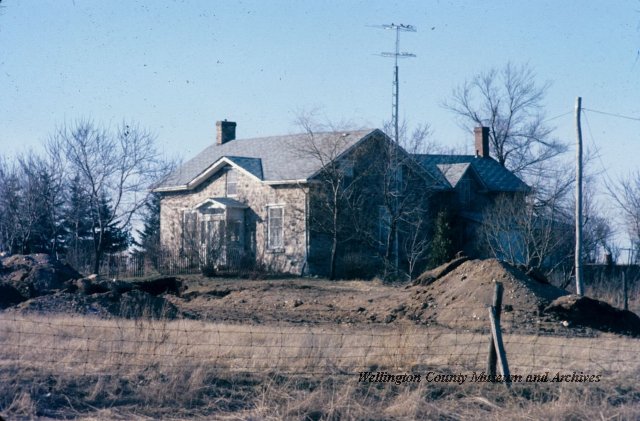
Copyright: Used by restricted permission from the Welling County Museum and Archives

Jeff described the property as he remembered it, “a small farm, with a large hill in the back, behind a large barn”.  Leanne confirmed that “there is still a hill in the back!  Behind the school are sports fields, and then it links with the local hydro corridor and municipal park.  It is a favourite place for tobogganing.”

Jeff further recalls: “There was an addition on the right side (facing the house) where Rod and Lourene lived until they bought their own farm.  As I remember, the kitchen was in the back (that’s where my grandfather would gather with my father and other siblings, to talk politics). And there was a living room on the right where we would play Euchre and a bedroom on the left. When I stayed there overnight, I’d sleep on an uncomfortable couch in the front right, below the window.”

It never ceases to amaze me, how we all originate from places “far and wide” and yet can converge with our distant relatives, decades and centuries later in a small town on the other side of the world!

Sources


[1] “England, Surrey Parish Registers, 1536-1992”, FamilySearch (https://www.familysearch.org/ark:/61903/1:1:QGZB-QJWV: Accessed 16 Jul 2024), Entry for William Carruthers and Delilah Pottinger, 27 May 1832.

[2] “England Births & Baptisms 1538-1975”, FindMyPast (https://www.findmypast.co.uk/transcript?id=R_934235527&tab=this: Accessed 16 Jul 2024) Entry for baptism of William Elijah Cruther, son of William Cruther and Delilah

[3] “England Births & Baptisms 1538-1975”, FindMyPast (https://www.findmypast.co.uk/transcript?id=R_934250418&tab=this: Accessed 16 Jul 2024) Entry for baptism of Benjamin Carruthers, son of William Carruthers and Delilah

[4] “England Births & Baptisms 1538-1975”, FindMyPast (https://www.findmypast.co.uk/transcript?id=R_938949957&tab=this: Accessed 16 Jul 2024) Entry for baptism of Mary Ann Carruthers, son of William Carruthers and Delila

[5] “England Births & Baptisms 1538-1975”, FindMyPast (https://www.findmypast.co.uk/transcript?id=GBPRS%2FSURREY%2FFHS%2FBAP%2F000050822&tab=this: Accessed 16 Jul 2024) Entry for baptism of Jane Carruthers, son of William and Delilah

[6] “England Births & Baptisms 1538-1975”, FindMyPast (https://www.findmypast.co.uk/transcript?id=R_948681930&tab=this: Accessed 16 Jul 2024) Entry for baptism of Thomas Carruthers, son of William Carruthers and Delilah

[7] The National Archives in Washington, DC; Washington, DC, USA; Passenger Lists of Vessels Arriving at New York, New York, 1820-1897; Microfilm Serial or NAID: M237; RG Title: Records of the U.S. Customs Service; RG: 36

[8] Year: 1851; Census Place: Middlesex, Canada West (Ontario); Schedule: A; Roll: C-11737; Page: 3; Line: 16

The Importance of Due Diligence in Genealogy Research

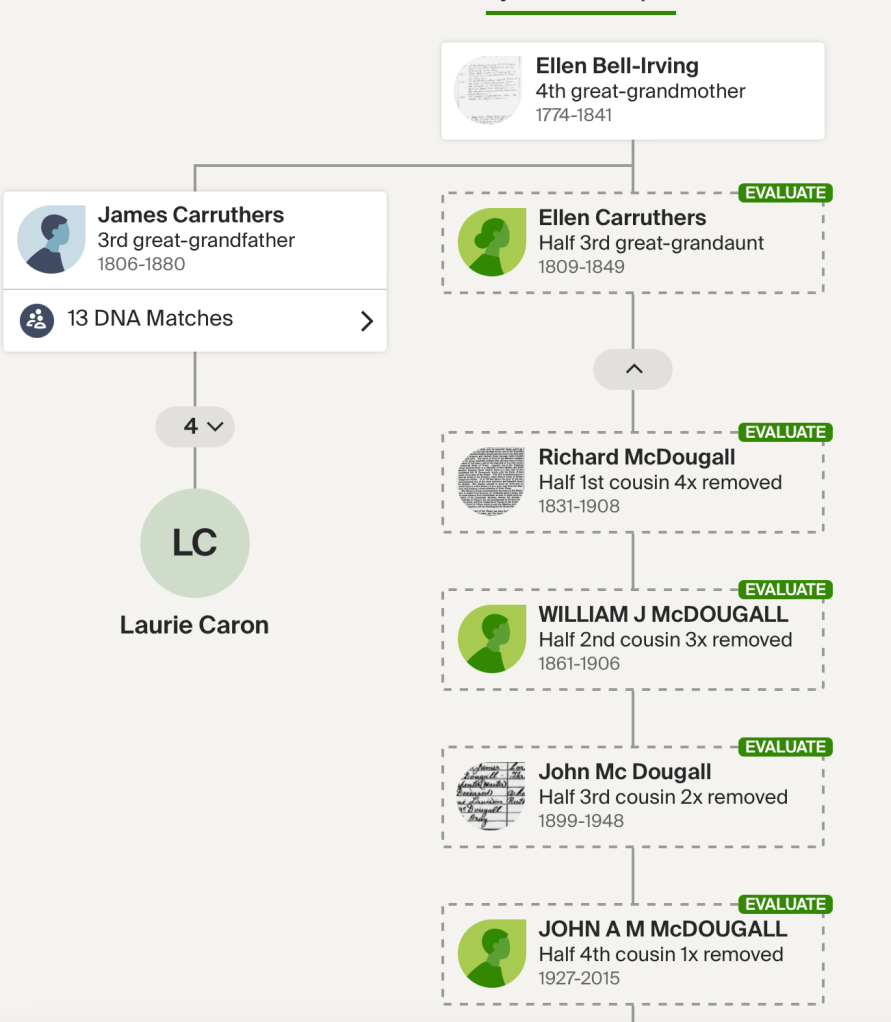
As the senior genealogist for Clan Carruthers – Canada, I regularly research records for our clan members, helping them to build their family trees and offer research advice.  While working on member’s family line which is fairly close to mine, I noticed that Ancestry’s ThruLines application was giving me a connection to my 4th great-grandmother, Ellen Bell-Irving, who was married to William Carruthers of Soriesyke.  This was an exciting revelation for me, as I do not have many connections with other descendants of her line.  But I was quickly disheartened.  Due to errors in several other family trees, the connection turned out to be false, all the result of a lack of due diligence from a single person, whose erroneous work had been perpetuated by others who copied the information without verifying the sources.

The ThruLines suggestion gave me McDougall’s as cousins to my 3rd great-grandfather, James Carruthers, descending through his sister, Ellen, whose parents are William Carruthers of Sorrysyke and his second wife Ellen Bell-Irving.

There is a marriage of an Ellen Carruthers to a William MacDougal on the 27 Jun 1830 in Saint Mungo Parish.  But the Ancestry transcription of that marriage does not supply parents’ names, and this is where the problem lies.  Novice genealogists often accept these transcribed source records arbitrarily without verifying the details.  This extra step of going to the true source, is crucial to maintaining accuracy in documenting a family tree.

It does cost money to locate the original image, since the only source for those Scottish images is either online at ScotlandsPeople.gov.uk, or in person at one of the search rooms at the National Records of Scotland.  However, it is well worth the money to secure the source image.

In this case, the image of the marriage record for Ellen and William does contain the father’s name for each party, and Ellen’s father is James Carruthers, not William.  What is even better is that the image also provides the residence of the parties and the residence of the parents.

Copyright: Used by restricted permission from the National Records of Scotland

This Ellen was living at Nutholm Shaw, and the residence of her father, James, is Brocklerigg.  That is very telling, because Brocklerigg is the farm where several of Ellen’s siblings were born, according to their baptism records, namely:  John (1813), William (1815), Mary (1817), Walter (1819), and George (1820) from James’ first wife, the first Mary Carlyle, who died in 1823, and also a half-sibling, Walter (1826) from James’ second wife, the second Mary Carlyle, who died in 1845.   

Unfortunately, the erroneously noted marriage source is the single record that has permeated errors throughout the descendants in the original owner’s family tree and has perpetuated those same errors through at least 8 other family trees on Ancestry, not to mention other genealogy sites, such as Geni, MyHeritage, and others.  On another disappointing note, it is impossible to have Ancestry correct the bad records.  We are dependent on the owners of the trees to correct the information.  Comments can be added on the trees, for visibility to other users, but tree owners can delete the comments.  Not all owners of trees are active on Ancestry, so while messaging the owners through Ancestry’s service can be helpful, more often than not, the tree owners are non-responsive.  As such, the errors could potentially create a domino effect for years to come.

To set the record straight, the Ellen Carruthers who was the daughter of William of Soriesyke and Ellen Bell-Irving married Edward McCann on 28 Aug 1838 in Saint Mungo Parish.  Similar to the above noted record, their marriage record identifies Ellen’s father as William Carruthers who resides at Sorrysyke. [Note:  Sorrysyke has various spellings throughout the centuries, to include Sorrysick, and there are notes on ScotlandsPlaces.gov.uk that say it was formally known as Milkvale, but commonly known as Sorrysike]

Copyright: Used by restricted permission from the National Records of Scotland

The records for William’s children are a bit scant, and a professional genealogist at the Dumfries & Galloway Council advised me that “when looking through the Parish Registers of St Mungo, I found several pages of written explanations by the Minister, Mr. Andrew Jamieson, who became Minister for the parish in 1809, after the parish being without a Minister for 6 years.  He seems to have taken all the old Registers of Baptism for St Mungo from Books and Session Records and other slips of paper and copied them all out into the book that survives today.  He states that he didn’t bother to copy the Burials and makes no mention of the Marriages.  This is the explanation why there are so many missing bits for St Mungo and so many apparent mistakes [copying records usually gives rise to a great deal of copying errors and mistakes].  He also tells that one particular Minister who was at the church from 1783 to 1803, never kept any records of Baptism, Marriage or Burial at all, and that there were at least two periods in the 1700’s where the Church at St Mungo had no minister, so no records were kept at all.”

Unfortunately, gaps in records causes some other research faux pas.  There are baptism records for an Elizabeth Carruthers, born 1777 to William Carruthers in Sorrysyke and a Mary Carruthers born 1781, to William Carruthers in Sorrysyke.  With extensive further research into other records, and DNA comparisons, we learn that this is not the same William of Sorrysyke that married Ellen Bell.  This William is the brother of John of Guileburn, who married Jean McAlister.  John of Guileburn was the father of the William of Sorrysyke that married Ellen Bell.  In other words, one William Carruthers of Sorrysyke was uncle to another William Carruthers of Sorrysyke.  

Despite those gaps and confusions between generations, there are some other indicators to determine the Sorrysyke William Carruthers and Ellen Bell family.  

  1. William was likely previously married, as a son, Christopher, was baptised on 22 Dec 1782 to Wm Carruthers in Sorrysyke.  This Christopher married Mary Carruthers, daughter to the above noted James Carruthers and his first Mary Carlyle wife.  Christopher died on 04 May 1844, and while his headstone inscription says that he died at Littleburn, his obituary published in the Dumfries & Galloway Standard & Advertiser says “At Guileburn”.  Either way, Guileburn and Littleburn are all of a 3-minute walk between each other.
  2. William second married Ellen Bell and had at least the following children.  
    • Phyllis – whose baptism cannot be found, likely due to the absence of a minister when she was born, but who died on 15 Feb 1809 and is buried at St. Mungo with her parents, but there is debate on her age when she died.  The tombstone inscription has been transcribed as though she was 18 years old, however an image of the headstone is rather degraded, but it appears she may have only been 18 months old.  I’m inclined on the latter, because if she was 18 years old, Ellen likely would not have been her mother.
    • Ellen – wife of the previously mentioned Edward McCann, was born on the 05 Feb 1809 at Guileburn and baptised on the 12th, only a few short days before her sister, Phyllis, died
    • John – born 12 May 1812 at Sorrysyke and baptised on the 7th
    • Jane – born 25 Feb 1815 at Sorrysyke (her birth year only being seen on the image) and baptised on 27 Feb 1817

My own 3rd great-grandfather, James, was born in 1806, and through yDNA testing, we have determined that he was also the son of William Carruthers and Ellen Bell, and he would have been caught in that gap where St. Mungo did not have a minister for 6 years, and as such a baptism record cannot be found.  This also may mean that William and Ellen had other children in that period from 1803-1809, who have yet not been identified.

I hope the evidence provided here will encourage the reader to exercise their due diligence when attaching source records in their family tree.  I strongly recommend securing original images to verify the transcribed information and to identify other details that may more conclusively provide the evidence needed.  Your extra effort will ensure the accuracy of your family tree for generations to come.

Leave a comment

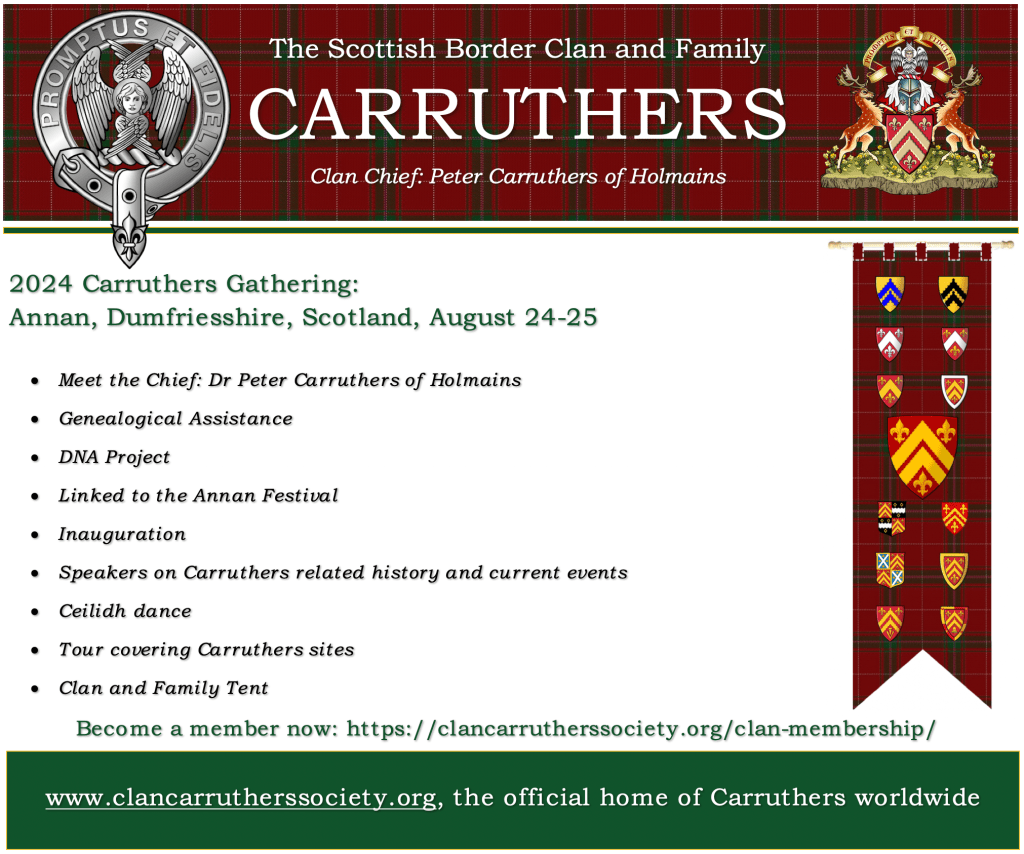
Carruthers Gathering Annan, Dumfrieshire August 24-25, 2024

In conjunction with the Annan Festival, and a beer festival in the town, Carruthers will hold their first official Gathering over the weekend of August 24-25 in Annan, Dumfriesshire.

Annan as a town is situated in the old West March it does of course take its name from Annandale and the river Annan which runs through it to the Solway Firth. It sits within Carruthers ancestral lands who owned lands on both banks of the river.


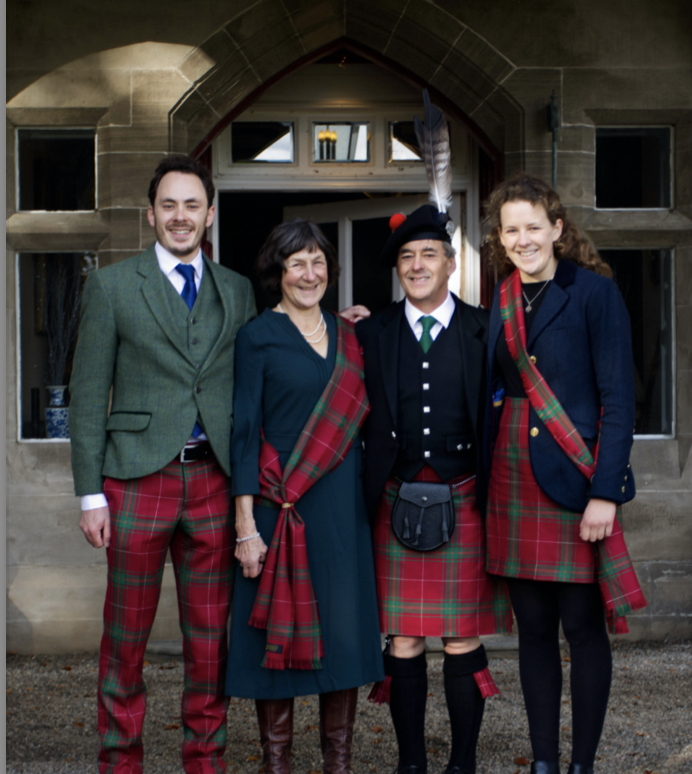
The Chief’s family: Asher (son, younger of Holmains and heir), Madam Judith of Holmains, Dr Peter Carruthers of Holmains (Chief), and their daughter Abigail


Current Planned Itinerary:

24 August 

The gathering will run in conjunction with the festival itself and the events being held. There is also a beer festival going on that day in the town. A Carruthers tent will be situated at the festival which will be occupied during the part of the day by one of our senior genealogists, our Director of DNA Research, our Commissioner and our Convenor. The Chief will be present and will share his time between the tent with other Chiefs and our own. 

At around 4:00 we will congregate at the Annan Distillery, a few minutes walk from the town where you will not only meet our chief, but observe him taking his oath to our clan and family and our affirmation of the same. At this point he will give a short speech of welcome. 

There are speakers organised to include:

  • Dr George Carruthers, Clan and Society Convenor, who will give a talk on the general history of the family
  • Ross McEwen, LLM, FSA Scot, who is a senior member of the leadership of Clan MacEwen and a Trustee of the Heraldry Society of Scotland, who will offer a talk on Chiefs and Chieftains in our modern world.
  • Philip Tibbetts, Lyon Court Vexillologist and March Pursuivant Extraordinary at the Court of the Lord Lyon, who will speak about the heraldry and flags of the Border families.
  • Steve Colburn, Director of the Clan Carruthers DNA Project, will talk about the latest Carruthers DNA updates.

This will be followed by time to chat and enjoy each other’s company before the meal is served, after which we will dance to the cèilidh band to finish off the evening. 

25 August 

We will again meet at the Distillery at 10 am for a tour and whisky tasting, after which a light buffet will be laid on. At around 12 for those who have booked, a tour of Carruthers sites in the area will commence accompanied by a tour guide.

After this, you will have free time to enjoy the area at your leisure. 

There will be a cost for the dinner/ dance, the buffet and the tour. Cost will be kept to a minimum but is still being calculated as prices come in. 

Official Carruthers merchandise will be on sale during the day of the 24th, in the Carruthers tent.

For further details please contact the Clan Commissioner for the United Kingdom, Mr Michael Carruthers : michaelcarruthers100@gmail.com

Places to Stay:

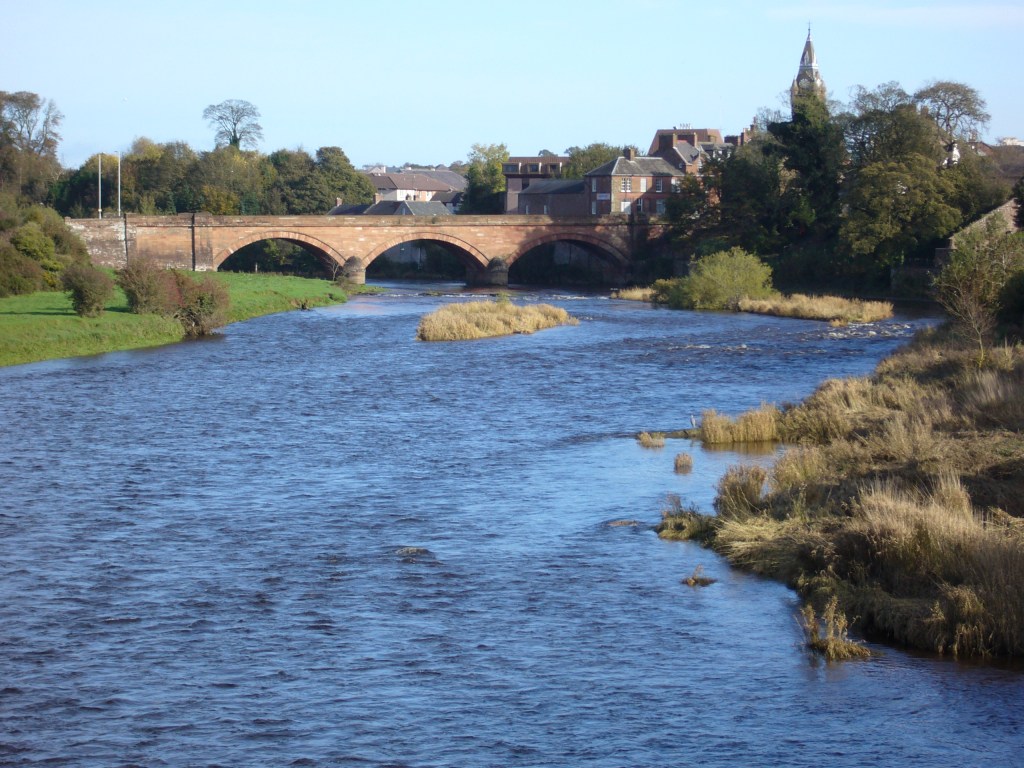
River Annan with the town of Annan in the Background


Annan and surrounding areas, lands of our ancestors.

The fords or “waths” which cross the eastern Solway Firth were the routes taken by invading armies for more than two thousand years. Their principal routes were then up into Annandale and Eskdale, of which Carruthers played their part in the wars and skirmishes of the area.

The Roman Empire of course was not confined by Hadrian’s Wall and they invaded what is now Scotland many times and established large camps and fortifications in Annandale itself, when securing their roads for their campaigns further north.

In the 13th and 14th centuries the Bruce family, who were the Lords of Annandale, took a very active role in the struggle for Scottish independence and the lands on both sides of the border suffered the consequences of outright war between England and Scotland. As a source of history, Annan itself was made a Burgh of Barony by the Bruces in the 13th century but the charter document was most probably destroyed during the border wars. This charter was re-erected by King James V in 1538.

Carruthers received thier own Charter of Lands in 1320 from Robert the Bruce and during their tenure as Lords of Annandale our family were their Stewards, as well as Keepers of Trailtrow Preceptory, Foresters of Annandale, and Guardians of the Old Kirk Ford at Hoddom.

Even in the times when both Scotland and England were at peace the valleys were subjected to raid and counter raid for around 300 years as the powerful families on both sides of the border made their living as “reivers”. The “reivers” were fast, well armed horsemen with no allegiance to either country who rode by night to steal cattle and any moveable goods. The many fortified tower houses and other structures, scattered around the area are a grim reminder of that turbulent past.

These include the ruins of Mouswald Tower, but for Holmains tower, only the groundworks can be see. The ruins of Threave Castle still stand, where Carruthers were Captains in support of Maxwell, and Comlongon Castle where Marion, daughter and orphan of Simon, last of Mouswald was found dead at the bottom of the battlements, allegedly killed by the Douglas for her lands. Little Dalton Kirk on the Old Holmains estate holds many a Carruthers.

As such, both the town and area around it are steeped in history, covering events and places Carruthers were involved. For instance in 1605, Holmains as Steward Depute of Annandale (one of the first Justices of the Peace for Dumfriesshire), along with other Lairds were called to quell the disturbances at Newbie Tower, just across the water from Annan. It seems some Maxwells and Jardines had taken the tower and killed its head. The Privey Council had sent the order to retake it and hold it

It is a place to relive and experience the land of your ancestors and further our chief sends a personal invite to you to attend.

Clan Commissioner for the UK, Michael Carruthers :michaelcarruthers100@gmail.com

What’s in a name and title?

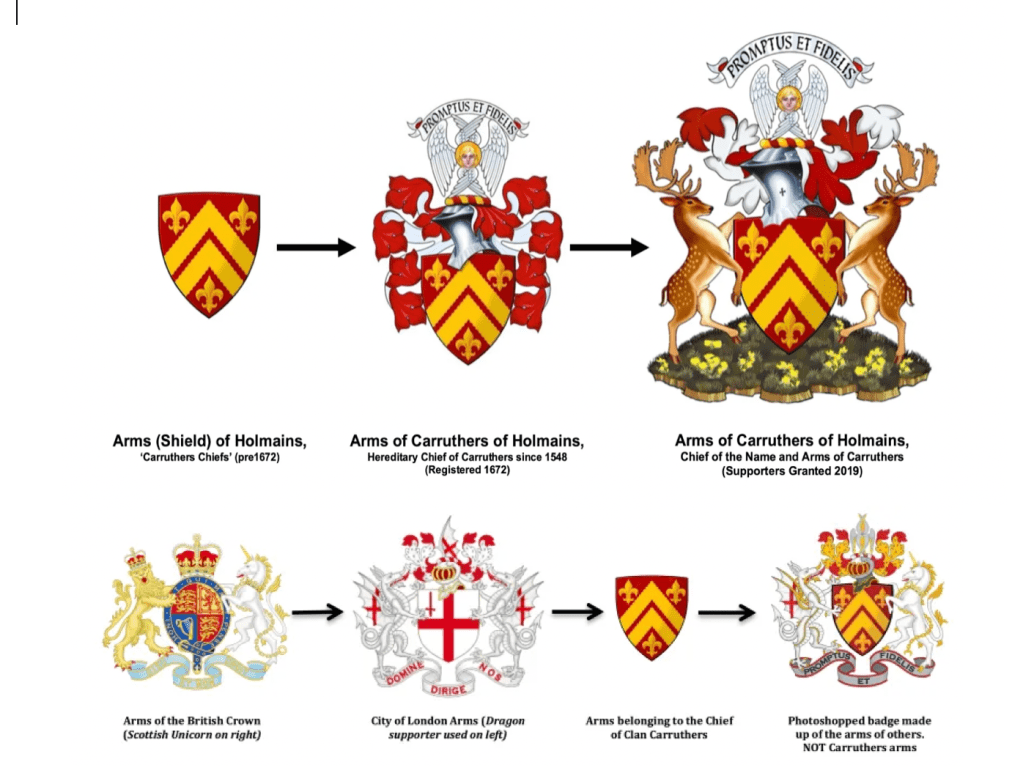
Legitimacy and credibility matters, especially if you care deeply and hold your Scottish ancestry with great pride. The difference between a coat of arms of a Scottish Chief, and that which isn’t is self explanatory.

Scottish arms belong to and individual and should not be used without their permission.

The shield of the chief is the main component of the arms and is copyrighted to him.

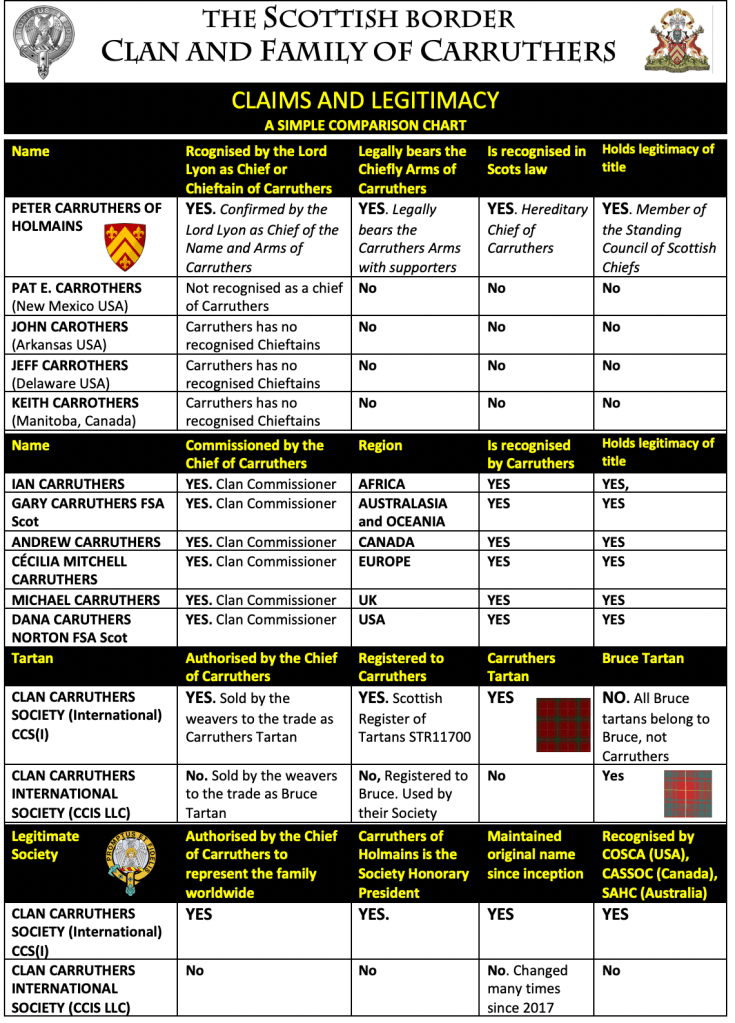
The arms above are that of the Chief of Carruthers, accepted and recognised in Canada as being matriculated through the Lord Lyon in Scotland, below thatis not recognised Carruthers arms.

The chart below may explain the legitimacy and credibility of claims made.

Who owns the Clan/Family Tartan of Carruthers

Sometimes, it is difficult to understand information others have posted, especially on things it is obvious they know nothing or very little about. However, the evidence, rather than an agenda driven supposition is always available to be seen if you choose to look for it.

With this in mind, today we will discuss and differentiate between a personal tartan and one that can be commercially sold as a clan/family tartan by the weavers, who as wholesalers sell directly to the trade.

The story of the Carruthers Tartan

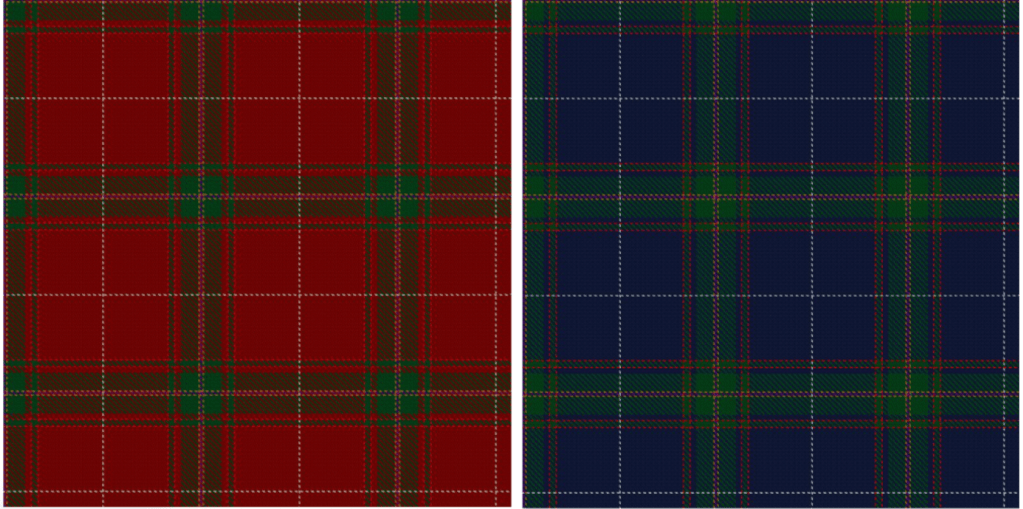
(L) official Clan/Family tartan of Carruthers, (R) Personal tartan

In 2017, in preparation for having a chief confirmed, Carruthers tartans were commissioned.

The Tartan Historian Brian Wilton MBE was asked to design two tartans one with a Blue base and the other Red

The colours of green, purple and lilac represents the lands of our family’s origins in Annandale, Dumfriesshire

  1. The base red represents the blood we spilt throughout our history for our country, our lands and our family at both home and abroad.
  2. Finally, but no less important, the subtle white stripe is in recognition of our family’s historic support for the Jacobite cause and the Royal line of Stuart.

The Red tartan is legally registered in the Scottish Register of Tartans (STR11700) as the official Clan/Family tartan of Carruthers. All official Scottish Clan/Family tartans are registered there and a copy of the tartans colours, threadcount and sett are recorded against the clan/family name.

The Carruthers tartan is woven by our weavers -the House of Edgar in Perth, Scotland.

The Blue tartan on the other hand, has its own meanings in its colours, but has been retained as a personal tartan by the Convenor and his family.


The reception of the Carruthers tartan.

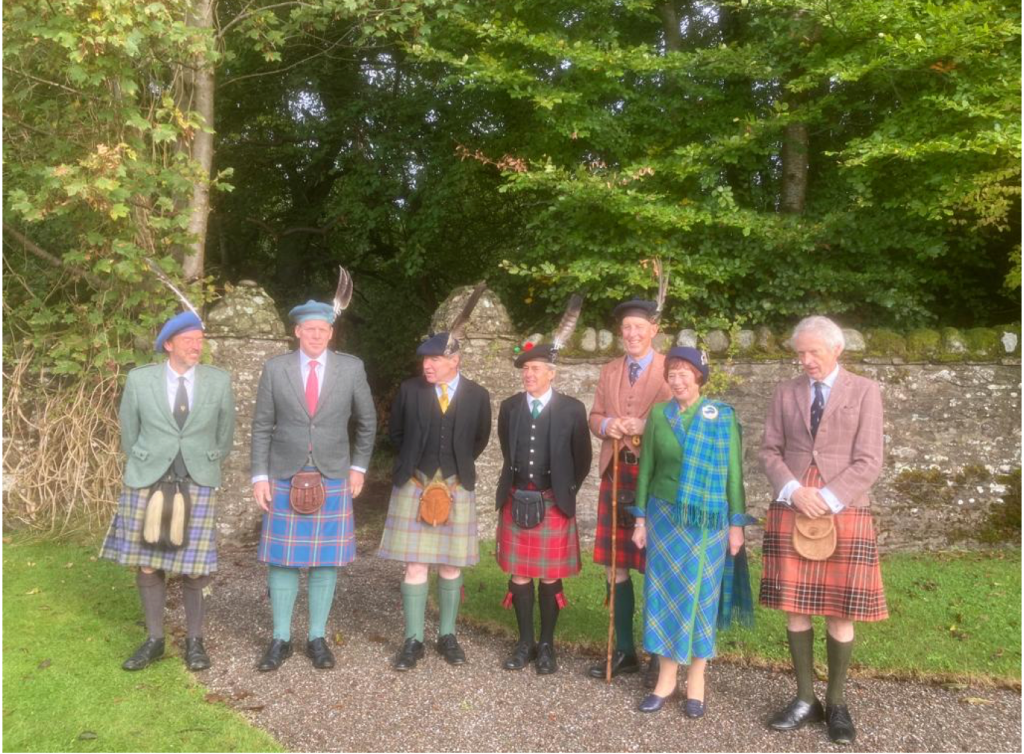
Carruthers Chief (centre) wearing the Carruthers tartan, with some of the other Chiefs present as guests of the Chief of Buchanan, at his inauguration.

Other than the usual critics who have their own agenda, what has pleased and surprised us the most is the number of positive comments that have been made regarding our tartan and from a number of sources. This includes our weavers, other clans and their Chiefs, commercial outlets and of course clanspeople from around the world. It is seen as both a vibrant and subtle reflection on the ancient history of our family and as such, we are very proud of it.


So what are the differences between a personal tartan and one that is not?

A personal tartan is for the sole use of the copyright holder and those authorised by him. This tartan therefore cannot be offered for sale or woven without the express permission of the copyright holder. This means that in the case of the Blue Carruthers tartan, its weave and use remains in the control of the registrant.

The official Carruthers Clan/Family tartan on the other hand, is recognised by the Clan Chief, Dr Simon Peter Carruthers of Holmains, Chief of The Name and Arms of Carruthers and is intended for all members of Clan Carruthers and other spellings of the Name. The weaver therefore can weave it commercially and sell it wholesale from their own stock, to the tartan trade.

Simplistically put:

  • No personal tartan could ever be recognised as a Clan/Family tartan and accepted for registration on the Scottish Tartan Register.
  • This is the same, whether it is Bruce, Macdonald, Elliot, Forbes etc and on the register itself any personal tartan will be listed and differentiated from that of a clan/family.
  • There can be more than one personal tartan or clan/family tartan or even district or military tartan listed, depending on the clan.
  • The weavers, as wholesalers can sell directly to the trade ie the House of Edgar, in Perth, Scotland – weavers of the official Carruthers tartan, will sell to USAkilts, for example who will list it for sale to the public. This would not happen if the tartan was registered as personal.
  • Commercial businesses such as Scotlandshop can also sell Carruthers tartan items, again buying straight from the weavers.

So is a personal tartan, the same as a coat of Arms?

Not really, other than the fact that they are both owned by an individual, but then again so is a car?

In this case, an example of ownership would be that Scottish arms belong and are registered to the grantee and not the family i.e. our Chief’s arms belong only to him. Conversely, the Blue tartan is also owned by an individual, but that is where any similarity ends.

The difference is that anyone can have a personal tartan registered, but not everyone can have a Coat of Arms. In Scotland a set process by petition to the Lord Lyon is followed, which can take years from start to the issuance of the Letters Patent and with no guarantee of a positive outcome.


Were Carruthers given or have any right of ownership or copyright to a Bruce tartan?

The claim that Carruthers owns the ‘Ancient Bruce‘ tartan is simply so very wrong and on so many levels – the clue of ownership is in the name.

Each tartan registered against a name, irrelevant of prefix or suffix ie ancient, modern, weathered, hunting etc, is of that clan or family and carries its own personal DNA in the form of its threadcount and sett. To be commercially viable, it has to be commercially able to be woven and sold, personal tartans are not commercial items.

Also, to suggest as some have, that no one used or bought the ‘Ancient Bruce’ tartan until after Braveheart and as such Carruthers claimed it for there own, is beyond ridiculous.

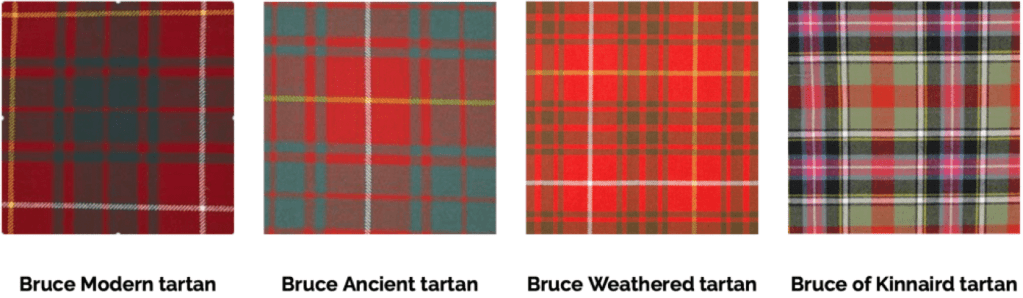
This is further disproved by its listing on the Family of Bruce International website where Ancient Bruce is shown and we are advised that it is one of the four most commonly worn Bruce tartans.

From the Family of Bruce International website


Also, and again based on silly claims, there is literally no weaver in Scotland (and we can say that without any fear of contradiction), who would say or even imply that a Bruce tartan was originally Carruthers or is now owned by us. Copyright law, common sense and respect for the name of Bruce would prevent it. Hence any tartan relating to that family is still called ‘Bruce’, ancient or otherwise.

Nonetheless, it is fair to state that the Bruce tartan has been listed as Carruthers. This was simply to attract those of our name, who as a sept of Bruce could wear their tartan, and allowed the businesses to sell to a wider catchment. We are not alone in this as this is no different to other families, also classed in this case as septs of Bruce, such as Randolph and Stenhouse.

However, at least for us, we are happy to report that this is quickly changing and the official Carruthers clan/family tartan is taking prominence in the sales and websites of commercial outlets.

For clarification of our growing status, abd from the website of the Family of Bruce International it clearly states: Carruthers has been a traditional Bruce sept, but now has its own chief and is its own clan. See http://www.clancarrutherssociety.org.


Summary

Although we were late to the party, no Clan/Family tartan existed prior to the early 1800’s. This led to the commercialisation of the ‘Scottishness in Vogue’ market during Victorian times. At this point and in order to increase their market share, clans/families without chiefs who had any historical relationship with a larger clan, were simply conjoined with them as septs.

Further it has to be pointed out that septs are a highland concept, not lowland nor border and were used for the reasons previously discussed above. The facts are well covered here.

However, in preparation for a Chief being confirmed and accepting Carruthers never had a tartan assigned to its name prior to 2017, one was designed and registered. After Carruthers of Holmains’ confirmation as Chief, the Carruthers Red was adopted and registered in the Scottish Register of Tartans as our official Clan/Family tartan in 2019.

So to wrap it all up, unless we are talking about a personal tartan, whether you choose to wear Carruthers, Bruce, Buchanan, MacGregor or Armstrong etc you still have to buy it somewhere. As such the profit share will always remain between the weavers and those such as the kiltmakers, but the ownership, as with Bruce, stays with the clan.


We sincerely hope this information, easily checked, can assist people in understanding the workings of Scottish traditions, in this case tartan registration, ownership and commercial access.